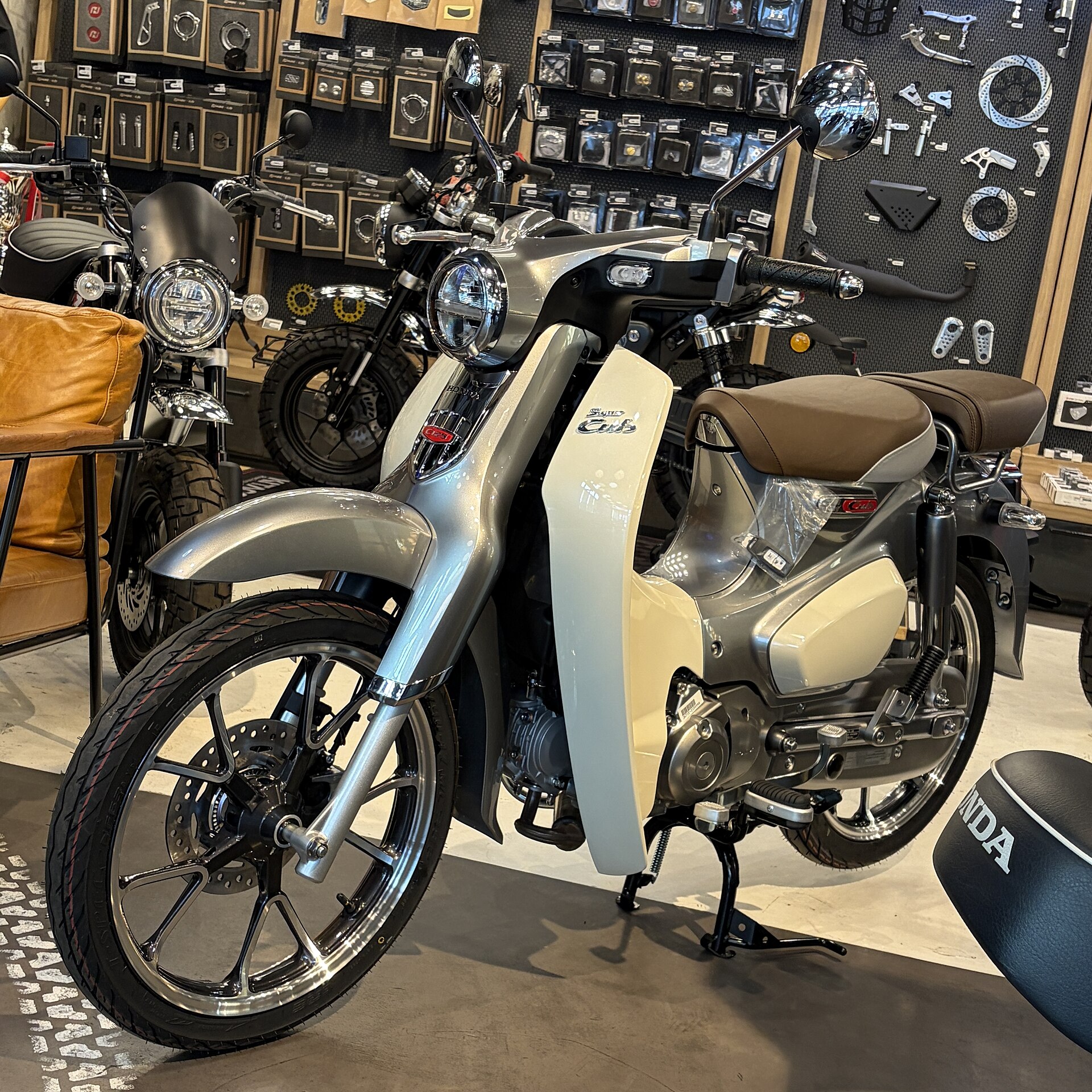
The Honda Super Cub is a small step-through motorcycle that Honda launched in Japan in 1958 and has kept in production ever since. Honda says more than 100 million Super Cubs have been built, and it is in everyday use in more than 160 countries. That makes it one of the most produced motor vehicles in history, and it is why a bike with 7 kW of power and a 111 kg kerb weight keeps turning up in lists about the greatest motorcycles ever made.
This guide covers where the Super Cub came from, what made the original so different, how it spread around the world, and what the current C125 offers a new rider. Every figure below comes from Honda’s own pages, which are linked in the sources at the end.
Why Honda built the Super Cub
By the mid 1950s Honda had learned that a clever machine is not the same as a machine people want. Honda’s 1954 Juno K scooter had a fibre-reinforced plastic body and all-weather equipment, but it was heavy and underpowered and it failed in the market.
In December 1956 founder Soichiro Honda and managing director Takeo Fujisawa travelled to Europe and saw how many people relied on mopeds and scooters for daily transport. They came home convinced Japan needed a motorcycle for ordinary people. Honda’s own history describes the target: a bike a noodle-shop delivery boy could ride with one hand while balancing a tray in the other, and one that customers in skirts could ride comfortably.
What made the 1958 C100 different
The first Super Cub, the C100, put several ideas together that were unusual for a motorcycle at the time:
- A step-through frame. A low backbone frame let riders step over it instead of swinging a leg over a tank.
- An automatic clutch. A three-speed automatic centrifugal clutch meant no clutch lever to operate.
- A four-stroke engine. Honda chose an OHV four-stroke for output, fuel economy and cleaner running.
- Protection from dirt. A resin leg shield kept feet clean, and a chain case kept oil off clothes.
- Big wheels. Specially made 17 inch tyres gave a steadier ride on rough roads.
- A tank under the seat. The fuel tank sat under the seat, which kept the step-through space open.
When Fujisawa saw the prototype he predicted 30,000 sales. A young designer asked if he meant per year. He said per month. At the time, the whole Japanese motorcycle industry was producing about 42,000 bikes a month, so this was a bold call.
How fast it took off
Honda’s figures show how quickly the Super Cub grew:
- 1958: about 24,000 built, in the first partial year after an August launch.
- 1959: about 167,000.
- 1960: the new Suzuka factory opened, with sales of 564,000 that year.
- 1961 and 1962: 661,000 and then 790,000.
Honda says Super Cub production expanded to 15 countries. In 1964 it added the C65, the first Super Cub with an overhead cam engine, and in 1966 the 49 cc C50. Honda reports that the overhead cam engine design from the C65 stayed the base for the final carbureted Super Cubs in the 2000s, and it also underpinned bikes such as the Monkey and Dax.
How it conquered the United States and Asia
Honda opened its first overseas sales company, American Honda, in 1959. The Honda 50 CA100 reached North America in 1962, and in 1963 the advertising line “You Meet the Nicest People on a Honda” changed how many Americans thought about motorcycles. Honda’s history credits it with shifting the image away from outlaw riders and toward ordinary young people.
In Asia the Super Cub became everyday transport. Honda began knockdown production in Taiwan in 1961 and local production in Thailand in 1967. It was first exported to Vietnam in 1965, and Honda’s history says the bike became so common there that people called all motorcycles “Hondas”. By 2020, Super Cub family models accounted for about 40 percent of Honda Vietnam’s total production of 30 million units.
The Super Cub today: the C125
The modern descendant is the Super Cub C125. Honda’s UK specification page lists these figures for the 2026 model:
- Engine: 124 cc air-cooled, single cylinder, 2-valve OHC with PGM-FI fuel injection.
- Power and torque: 7.2 kW at 7,500 rpm and 10.4 Nm at 6,250 rpm.
- Gearbox and clutch: 4-speed transmission with a wet multiplate and automatic centrifugal clutch.
- Weight and seat: 111 kg kerb weight and a 780 mm seat height.
- Fuel: a 3.7 litre tank and a stated 1.5 L/100 km on the WMTC cycle.
- Brakes: a 220 mm front disc with single-channel ABS and a 110 mm rear drum.
- Lighting: LED headlight and taillight, with an LCD instrument display.
- UK price: from £3,999 at the time of writing.
Prices and availability differ by country and model year, so check Honda’s site for your market before you plan a purchase.
Is the Super Cub a good first motorcycle?
For a new rider who wants a simple, light bike for short trips, the Super Cub’s basic design is easy to like. The step-through frame is easy to get on and off, the low seat height and light weight make slow manoeuvres less daunting, and the automatic clutch removes the clutch lever. If you want to understand what that setup means, our guide to wet and dry motorcycle clutches explains the basics.
Some limits are worth knowing. It is a small bike with modest power, so it suits towns and quieter roads better than fast highway riding. You still shift gears with your foot, so it is not an automatic scooter. And any motorcycle still needs training, protective gear and the right licence where you live. Our guide to how much a motorcycle costs can help you think about the rest of the budget.
If you like small Honda bikes, you may also want to read about the Honda Grom’s top speed.
Frequently asked questions
Who made the Honda Super Cub?
Honda. The first Super Cub, the C100, was developed under founder Soichiro Honda and managing director Takeo Fujisawa and went on sale in Japan in 1958.
How many Super Cubs have been sold?
Honda says more than 100 million Super Cubs have been produced worldwide. Production figures differ from sales figures, so treat that as Honda’s own production total.
Does the Super Cub have a clutch?
Yes, but the rider does not operate it. It uses an automatic centrifugal clutch, so there is no clutch lever. You still change gears with your foot.
What engine does the Super Cub C125 have?
According to Honda’s UK specifications, it has a 124 cc air-cooled single cylinder engine that makes 7.2 kW and 10.4 Nm.
Is the Super Cub still made?
Yes. Honda lists the C125 as a 2026 model in its UK range.
Sources
- Honda Global: Cub, for the 100 million units and 160 countries figures.
- Honda Global: the invention of the Super Cub, for the history, production figures and market expansion.
- Honda UK: Super Cub C125 specifications, for the 2026 specifications and UK price.
Featured photo: 2026 Honda C125 ABS by Chanokchon, Wikimedia Commons, licensed CC BY-SA 4.0.

